
Near-Vertical Rotors
Common Applications of Near-Vertical Rotors
- Density gradient centrifugation
- Isopycnic centrifugation
- DNA and plasmid purification
- Viral particle isolation
- Lipoprotein separations
- Biomolecule purification
- Rate-zonal and equilibrium density separations
- High-resolution ultracentrifugation workflows
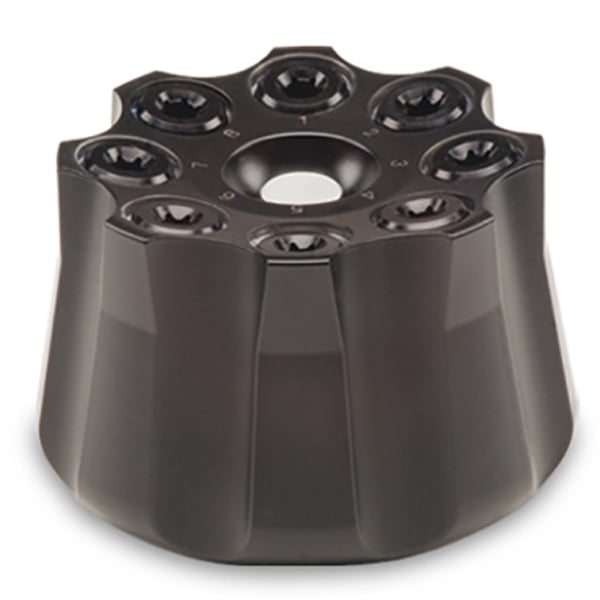
Near-vertical rotors are designed for high-speed density gradient separations where short run times and high-resolution are critical. In these rotors, sample tubes are positioned at a shallow angle relative to the axis of rotation, creating a shorter sedimentation path than conventional fixed-angle rotors. This design can help accelerate separation while maintaining excellent resolution for gradient-based ultracentrifugation applications.
Near-vertical rotors are commonly used for isopycnic centrifugation, density gradient centrifugation, nucleic acid purification, viral particle isolation, and other biomolecular separations where particles migrate to their equilibrium density. Their short path length can reduce run times while supporting efficient separation of closely related biological particles.
Beckman Coulter Life Sciences offers a range of near-vertical rotors for ultracentrifugation workflows requiring high-resolution, high-throughput, and optimized density gradient performance.



FAQ on Near-Vertical Rotors
What is the difference between a near-vertical rotor and a fixed-angle rotor?
A fixed-angle rotor is typically optimized for rapid pelleting applications, while a near-vertical rotor is often chosen for density gradient and isopycnic centrifugation workflows. Near-vertical rotors provide a shorter path length within the gradient, which can help reduce separation times for equilibrium and gradient-based applications.
Why are near-vertical rotors used for density gradient centrifugation?
Near-vertical rotors provide a shorter sedimentation path than many other rotor designs. This can reduce run times and support efficient density gradient separations while maintaining resolution between particles with different buoyant densities.
Why choose a near-vertical rotor for DNA purification?
Near-vertical rotors are commonly used in density gradient-based nucleic acid separation workflows because they can support efficient migration of DNA molecules through the gradient while reducing run times compared with some traditional rotor configurations.
What is a near-vertical rotor?
A near-vertical rotor is an ultracentrifuge rotor that holds sample tubes at a shallow angle between vertical and fixed-angle orientations. This geometry creates a shorter sedimentation path, helping reduce centrifugation times while maintaining high separation efficiency.
What applications are near-vertical rotors commonly used for?
Near-vertical rotors are frequently used for density gradient centrifugation, isopycnic separations, DNA purification, viral particle isolation, lipoprotein analysis, and other high-resolution ultracentrifugation workflows.
What is isopycnic centrifugation?
Isopycnic centrifugation is a density gradient separation technique in which particles migrate until they reach a position where their density matches the density of the surrounding gradient medium. Near-vertical rotors are commonly used for these applications because they can support efficient equilibrium separations.
